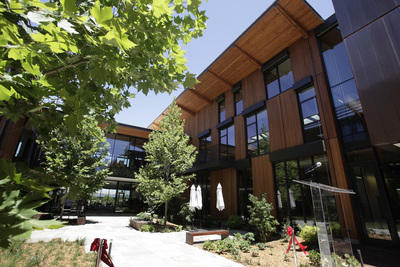
Climate change, energy efficiency and environmental responsibility are now strategic factors in many a local planning department, architect’s practice and commercial developer’s office. The implementation of ‘green building’ policies in the 21st century are now seen as crucial to creating energy saving spaces in which humans can safely live and work.
Protected interior planning
New breed technologies have enabled key environmental materials such as window tinting films to evolve as essential tools in the frontline of protected building interior planning. From reactive clear and dual reflective films to high-end nano sputtered particle and ceramic layered films, a range of multiple solar UV radiation and infra red heat rejection systems are being increasingly seen as playing a vital role in today’s key commercial or public developments.
South Africa also plays her part in helping to provide for a safer future. Established in 2007 by leading members of the commercial property industry, the Green Building Council of South Africa (GBCSA) is an independent organisation with a stated aim of ensuring “that all buildings are built and operated in an environmentally sustainable way so that all South African’s work and live in healthy, effective and productive environments.”
Green building measures
According to the GBCSA, a ‘green building’ is defined by “the use of design, materials and technology to reduce energy and resource consumption and create improved human and natural environments.” To achieve this goal they consider specific green building measures should include:
- Careful building design to reduce heat loads.
- Maximum natural light and circulation of fresh air.
- Use of energy-efficient air-conditioning and lighting.
Green Star SA rating tool
From 2011/12 onwards, a Green Star SA rating tool was developed GBCSA, which was based on the Green Building Council of Australia tools, and aimed to provide the property industry with an objective measurement for green buildings to be incorporated. Points are awarded to a building according to which measures have been adopted to determine a final rating. Each Green Star SA rating tool reflects a different market sector, whether office commercial, retail, multi unit residential, etc
It’s increasingly evident that anti glare solar UV control films, which can block up to 90 per cent of heat and 99 per cent of UV light transmission have a direct impact on interior space cooling and heating efficiency. New responsive tinting films react to visible light and heat levels interactively, transforming window views from clear to opaque while seasonal specific ‘winter’ films perform to optimal heat energy conservation requirements.
About the Author – Rico Lowe is the author of this post and the owner of a company called sola Tint and Style. Rico and his window tinting team have over 25 years of experience in the field.